AAMI Newsletter — Issue No. 6
Preparing compassionate professionals for the world’s most dignified, AI-proof career.

Welcome to issue four of the AAMI Newsletter. We promise not to clutter your inbox — only updates once or twice a month on all things AAMI. In this edition:
BREAKING: New Application (Now live)
The Big Story (The Deepfake Eulogy: A New Liability Danger…)
Hot Topics (Quick headlines)

BREAKING: Our New College Application is Finally Here — Fast & Easy to Complete
We heard you. The era of the "prehistoric," multi-page application is over.
We’ve reimagined the entire process, replacing pages of paperwork with essentially one single, streamlined form. What used to be (literally) 20 pages and took (figuratively) three years to complete is now ancient history.
This transition offers several key benefits:
One Page only
Two Minutes to complete
Super Easy and narrowed down to only the essentials.
Share this news now with a prospective student, so they can join a program that maintains a nearly 90% post-graduate employment rate. We’re sorry for the delay. Modern times are now upon us.

The Big Story
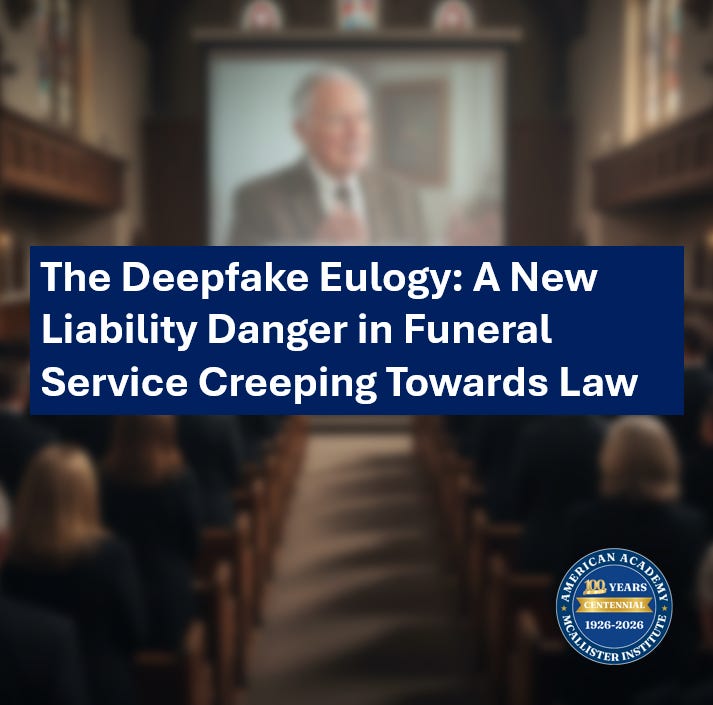
The Deepfake Eulogy: A New Liability Danger in Funeral Service Creeping Towards Law
For over a century, a funeral director’s “Chain of Custody” ended at the graveside. But as of early 2026, that chain has extended into the digital afterlife, bringing a high-stakes legal trap: the unauthorized digital replica.
Imagine a service where a family plays a “Deepfake Eulogy” - a hyper-realistic AI video of the deceased delivering their own final farewell. It is a powerful moment of closure until a dissenting heir files a lawsuit against your firm for hosting it. This is no longer a theoretical “sci-fi” scenario; it is a matter of immediate compliance.
The Legal Teeth
Authoritative legal shifts in New York and California have fundamentally redefined “digital remains”:
The New York Mandate: As of December 2025, NY updated its Civil Rights Law (§ 50-f), making it a civil offense to use a “digital replica” of a deceased person without explicit consent from heirs or executors. Crucially, the law now removes the “likelihood of deception” requirement. If the replica isn’t authorized, it’s a violation - period.
California’s Expansion: Effective January 1, 2026, California expanded its post-mortem rights to specifically cover “AI-generated digital replicas,” protecting an individual’s likeness for 70 years after death.
Federal Watch: The NO FAKES Act of 2025, currently moving through the 119th Congress, seeks to create a federal right for all individuals - not just celebrities - to control their digital voice and likeness.
Why the Funeral Home is at Risk
Under these new statutes, a funeral home providing the screen, the audio system, or the livestream platform for a deepfake memorial could be held liable as a “distributor” of unauthorized media. If “Sibling A” creates an AI version of a parent that “Sibling B” finds offensive or a violation of the estate’s rights, your firm is the one that physically facilitated the infringement.
The Bottom Line: You wouldn’t perform a cremation without a signed permit. In 2026, you should not host a synthetic memorial without a Digital Likeness Release. As the industry shifts from caretakers of the body to custodians of the legacy, your “standard contracts” must evolve to protect you from the digital beyond.

📝 AAMI Blog: What to expect as a student - Get the Scoop
💻 New App: Complete the new AAMI application in minutes - Apply Now
🤖 The Atlantic: Re-animating the dead: who “owns” them? – Read Now
🌟 BBC Story: Andy Goldsworthy and gravestone artwork - Learn More


